
Business Performance Agent
Ask the business a question. Get the number, not a ticket.
A Business Performance Agent lets anyone ask the company's numbers a question in plain language — customer count, churn, recurring revenue, average revenue per user — and get a reconciled answer from the governed warehouse. No SQL, no analyst queue, no arguing about whose spreadsheet is right.
The job to be done
“Every time I want a number I raise a request with the data team and wait three days. By the time it arrives the meeting is over.”
Before
A queue of ad-hoc data requests, and four versions of the same metric in four different decks.
After
A direct answer in seconds, drawn from the one governed source everyone agrees on.
How it works
- 1
Understands the question
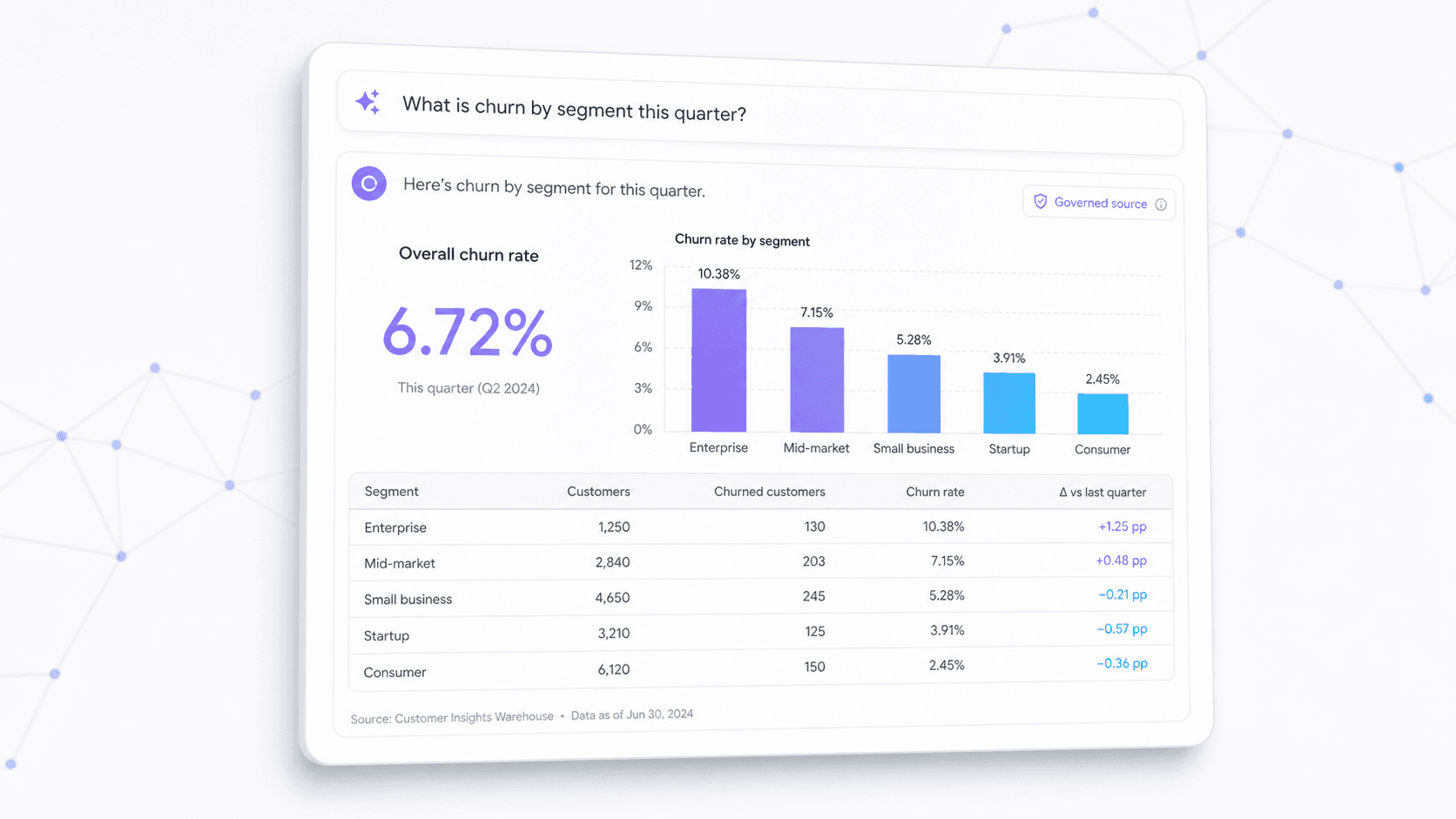
Takes a plain-language question — "what is churn by segment this quarter?"
- 2
Queries the warehouse
Runs against the governed data model, so the definition of churn is the agreed one.
- 3
Returns the answer
Gives the number, the table behind it and a chart, with the reasoning visible.
- 4
Respects permissions
Row-level security means people only ever see the data they are entitled to.
Where this one was built
Built for an ASX-listed telco, starting with the finance team and their governed warehouse.
Questions
What is a Business Performance Agent?
It lets anyone in the business ask the company's numbers a question in plain language — customer count, churn, recurring revenue, average revenue per user — and get a reconciled answer straight from the governed data warehouse. No SQL, no request queue.
How is this different from a BI dashboard?
A dashboard answers the questions somebody anticipated. This answers the one you actually have. Dashboards are where analysis stops; a conversational agent is where it starts.
How do we know the numbers are right?
Because it queries the governed data model rather than a spreadsheet. Churn means what your business agreed churn means, and every answer resolves to the same definition — which is usually more than can be said for four decks from four teams.
Can people see data they should not?
No. Row-level security is enforced in the warehouse, so the agent can only ever return data the person asking is already entitled to see.
Want this one running in your business?
We will scope it against your systems, build it, and teach your team to build the next one themselves.
.png&w=96&q=75&dpl=dpl_C4hMsrFjgZaVnuhJpbBN2ZsRJRXU)